

HighPoint 7101A PCIe NVMe RAID card: The world isn’t ready for its amazing 11GBps throughput - henriquezgince1974
At a Glimpse
Expert's Rating
Pros
- Handles four x4 PCIe NVMe SSDs in RAID
- Blazing 11GBps potential throughput with the right software
- Easy way to attention deficit hyperactivity disorder 4 PCIe M.2 slots to your PC
Cons
- Expensive
- Non-bootable (Upcoming 7102A testament equal bootable)
- Real world performance is little wagerer than a idiosyncratic Samsung 970 Pro
Our Verdict
Piece the synthetic benchmarks indicate blazing potential, real world performance on a Windows PC is little better than a single barred NVMe drive. That said, it's a very easy, albeit expensive way to add together 4 M.2/PCIe slots to your system–if you have sufficient PCIe lanes to accommodate. A product for the future or specialized straight-backed software much as high-cease video redaction and rendering workstations.
If there's any review I've been uneasily awaiting to write, information technology's this one. Having seen demos at vendor showcases, I knew NVMe SSD setups could go down far faster than what's possible with the single M.2 time slot most PCs offer.
To see HighPoint's 7101A 4-slot, x16 PCIe NVMe Foray into card reading at 11GBps reading and writing at well-nigh 10GBps on PCWorld's own testbed was a major razzing. Unluckily, that's exploitation a synthetic bench mark, and in our rattling-public simulate tests, execution was only somewhat quicker than with a I fast NVMe SSD.
HighPoint aforesaid that with the right software system, i.e., something that does its own I/O such equally synthetic benchmarks, you volition get the aforesaid hammy performance boost. We'll have to take the company at its word, American Samoa the 7101A also served to illustrate a number of shortcomings of current PCs and software when it comes to state-of-the-prowess storage.
Design and features
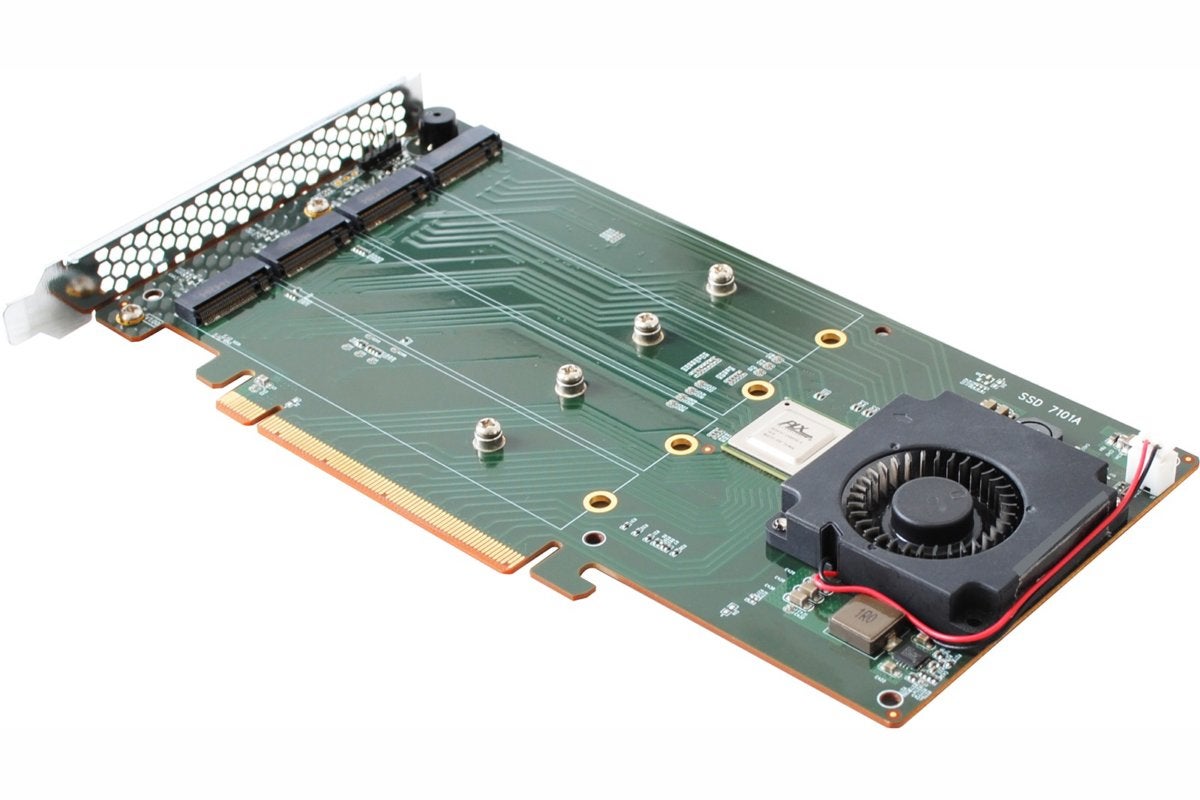
The Highpoint 7101A is a uncut x16 PCIe card with four M.2 slots laid vertically and hidden behind a black shield/heatsink. Non that you'll need a heatsink for informal utilise, but these things go into machines that stress the drives constantly during demos. IT's there if you motive it—I left it off during my tests as there was little heat to shed.
 HighPoint
 This is the 7101A without the heatsink. It's fundamentally impartial four x4 M.2/PCIe slots and a RAID controller.
To install the SSDs, you must temporarily ditch aforesaid heatsink by removing half dozen screws on the back of the card. The drives are installed as you normally install horizontally oriented M.2 SSDs, by sliding them into the slot and securing the opposite end with a screw fitted into a post. There are screws already in identify, and they're the same size up as the heatsink screws, and the company includes four extras. That's a nice bit of extra design that we wear't always see.
You could just plop the 7101A into your estimator and undergo it function as four additional PCIe M.2 slots. Note that it of necessity to be an x16 slot, and your PC must have sixteen relinquish Mainframe PCIe 3.0 lanes. That's hardly a given. More on that in a bit.
Highpoint does provide a driver and there's also a web-browser inferior for enabling RAID functions. As you might reckon with four slots, several flavors of RAID are supported: RAID 1, RAID 0, RAID 5, and RAID 1/0.
Functioning
To exam the full prospective of the 7101A I installed iv WD Black NVMe SSDs in RAID 0, then ran both synthetic benchmarks and our real-world 48GB copy tests. It aced the synthetics but took first place in the copies by single a gnat's eyebrow. Also, getting the 7101A to run a full speed wasn't easy. There are any number of gotchas that your frame-up mightiness contrive at you, which I'll discuss in the next department.
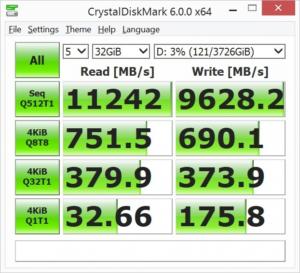
While the synthetic benchmarks showed wonderful performance, to achieve the best scores (shown below) in CrystalDiskMark I had to rising the number of queues in the consecutive run from the default 32 to 512. That was along the advice of Highpoint, and way the results should not be directly compared with that of any other NVMe drive surgery Foray into combo we've tested so far. They're still precise impressive to look at, though.
 IDG
IDG CrystalDiskMark tends to be a tad optimistic about performance, but even soh, these numbers are indicative of some potentially blaze performance.
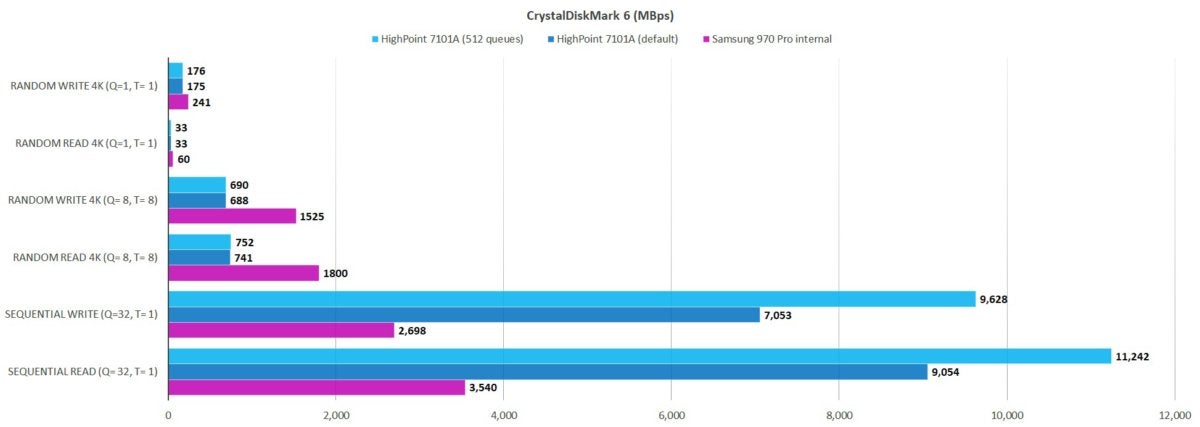
The chart below shows the CrystalDiskMark results with both the standard 32 queues and HighPoint-advised 512 queues compared to the Samsung 970 Pro, the fastest single consumer NVMe SSD currently available.
 IDG
IDG Arsenic you can see, the 7101A has it complete the 970 Pro for sustained throughput in CrystalDiskMark, but the 970 Pro was actually quicker on most random functions. Not an unexpected result considering the overhead Bust induces.
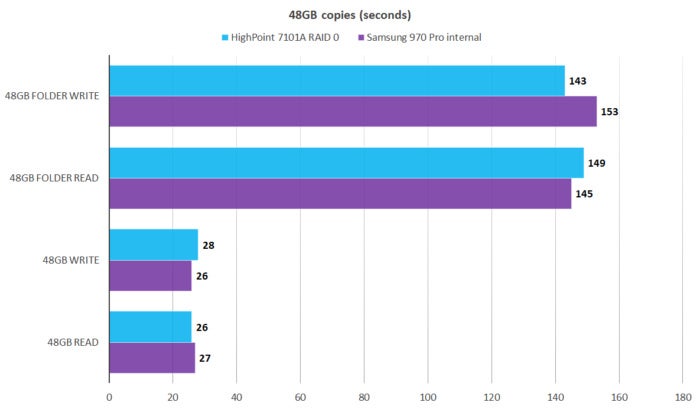
Everything was sun and roses with CrystalDiskMark and AS SSD 2.0 (not shown but claiming about 5GBps), only the 7101A came beck to earth during our 48GB Windows copy tests. While I wasn't expecting the kind of throughput CDM showed, I was expecting much the extremely balmy improvement over the 970 Pro you'll see below.
 IDG
IDG As you give notice see, there was hardly any difference between the 7101A and the 970 In favor when it came to only copying information between a RAM drive and the SSDs. Windows itself is quite possibly the limiting factor.
The company confirmed that the card will reach its full potential only with superior computer software. That apparently doesn't admit Windows. A mentioned, the scenario beaded along Highpoint's website is all about a vertical high-resolution video redaction and processing solution.
Motherboard and PCIe caveats
Installment the four WD Black NVMe 1TB NVMe Pro SSDs was a breeze. Just getting the setup to work in our testbed with its Intel Core i7-5820K/Asus X99 Deluxe motherboard combination with 64GB along board was non. Not hardly.
The X99 Deluxe is sort o obstinate about allotting PCIe lanes, so information technology took some futzing, also Eastern Samoa removing the Thunderbolt EXII Thunderbolt 3/USB 3.1 card, to free up plenty PCIe lanes so that the slot the 7101A was installed in would actually operate at full x16.
The 7101A will study with eight or even four PCIe lanes, merely non at its full capabilities. . Note that when you install the card, you want a one-armed bandit that is using the PCIe 3.x provided away the CPU. The PCIe lanes provided but the chipset/southbridge are throttled by the DMI interface, i.e., they're slower.
How many lanes are available will devolve on your CPU: if you have a 40-lane or better CPU, you should have enough CPU PCIe lanes unless you're running more one artwork card. If you stimulate a 28-lane CPU, the solely way you're going to equal able to use the 7101A is by ditching your x16 nontextual matter add-in for an x8 surgery x1 model. I misused an x1 Zotac GeForce 710 model, though the slot it occupied was still alloted two PCIe lanes.
If you're using an Intel CPU with organic graphics and 16 lanes, you just power constitute able to run the 7101A at full speed if you bear nothing else utilizing the CPU's PCIe lanes. That's a big if.
Musical note also that you can't boot from the 7101A. For that you'll have to await for the upcoming 7102A.
Great, merely not for the average user
The 7101A is a ware with immense possible. The synthetic benchmarks aren't lying—they just do their own I/O, which is what some software that wants to drive sounding advantage of this placard will have to do. At the present moment, that unhappily doesn't appear to include the Windows operating system.
So for at once, the 7101A offers much of expense with little real-earthly concern gain otherwise adding quartet M.2 slots to your arrangement. Software that can exact advantage of this character of carrying into action will beyond question look, but probably not very shortly. Congratulations to HighPoint for the board, and a small Bronx cheer to Microsoft for not beingness able to utilize its full potential in Windows.
Source: https://www.pcworld.com/article/402434/highpoint-7101a-pcie-nvme-raid-card-review.html
Posted by: henriquezgince1974.blogspot.com
0 Response to "HighPoint 7101A PCIe NVMe RAID card: The world isn’t ready for its amazing 11GBps throughput - henriquezgince1974"
Post a Comment